
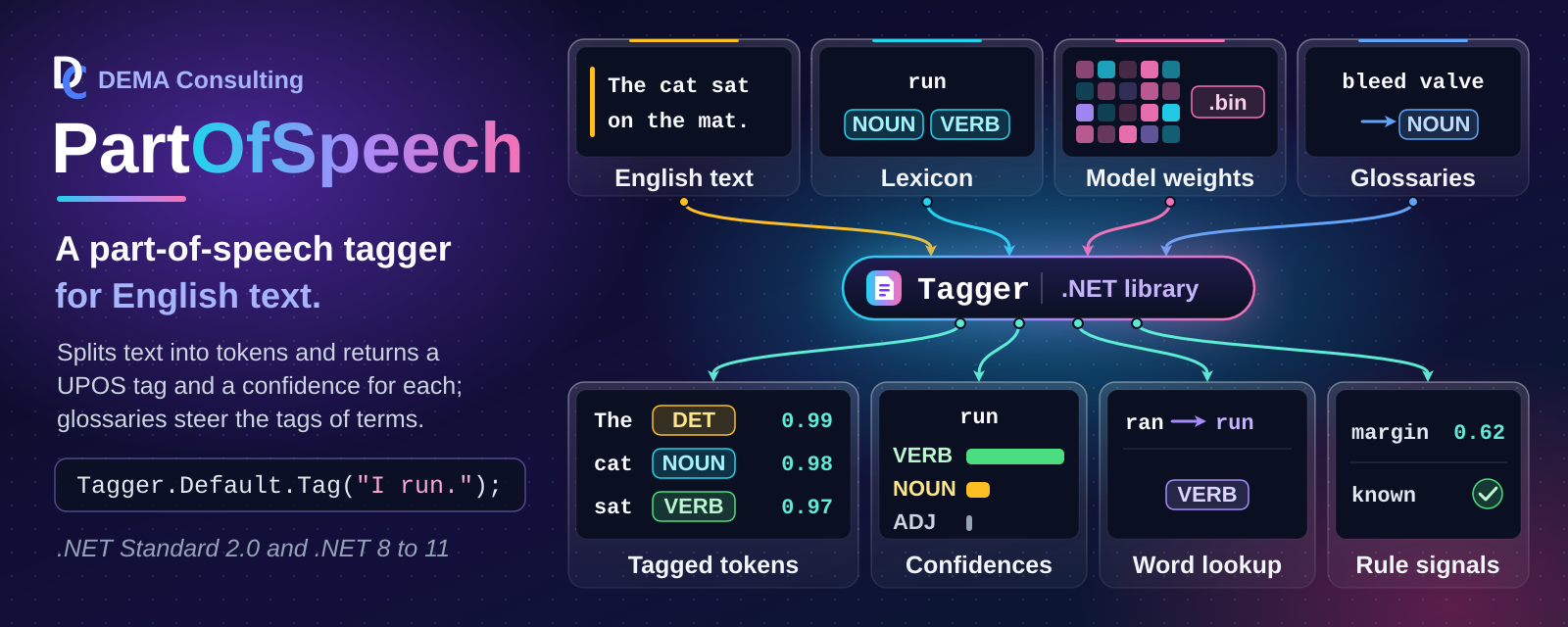




.NET library for part-of-speech tagging of English text, with calibrated confidences.
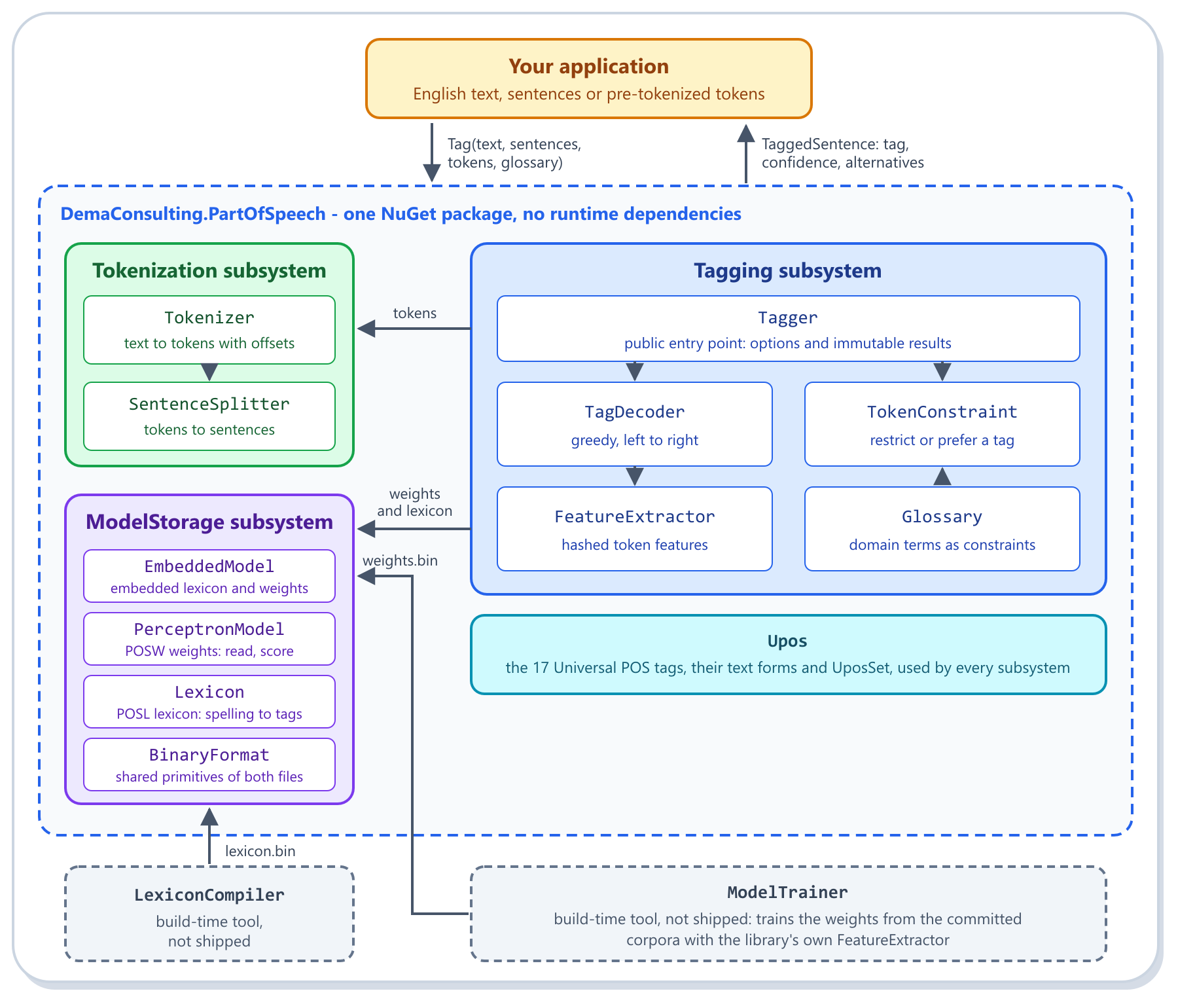
- 🔤 Tokenizer - English text to sentences and tokens with offsets
- 🏷️ Tagger - 17 Universal POS tags from an averaged perceptron
- 📊 Confidences - calibrated probabilities and ranked alternatives for every tag
- 🚦 Rule checker signals - margin and known-word flag per token
- 🔎 Word lookup - possible tags, base words and forms
- 🔒 Constraints - restrict or steer the tag of single tokens
- 📚 Glossaries - tag domain terms correctly, in hard or soft mode
- 🧩 Pre-tokenized input - tag tokens that you already have
- 📦 No dependencies - lexicon and weights are embedded, nothing to download
- ⚡ Fast - hundreds of thousands of tokens per second, thread-safe
- 🎯 Wide support - .NET Standard 2.0 and .NET 8 to 11
- 📄 API reference - generated Markdown reference packed with the library
- ✅ Continuous Compliance - evidence generated on every CI run
Install the library using the .NET CLI:
dotnet add package DemaConsulting.PartOfSpeechusing DemaConsulting.PartOfSpeech;
foreach (TaggedSentence sentence in Tagger.Default.Tag("The cat sat on the mat. It didn't move."))
{
foreach (TaggedToken token in sentence.Tokens)
{
Console.WriteLine($"{token.Text} {token.Tag.ToTagString()} {token.Confidence:0.00}");
}
}Tagger.Default is a shared, thread-safe tagger that uses the model and the lexicon that are embedded in the package,
so it needs no file and no download. The first read inflates and validates the embedded files once. To use other
weights, create a tagger with Tagger.Load(stream). The user guide explains confidences and
alternatives, constraints, glossaries and the tokenization conventions.
To tag domain terms correctly, give the tagger a glossary. The general model reads bleed in bleed valve as a verb;
the glossary says that the term is a noun, also in the plural and at the start of a sentence:
Glossary glossary = new GlossaryBuilder
{
    { "bleed valve", Upos.Noun, "A valve that releases trapped air." },
    { "torque wrench", Upos.Noun },
}.Build();

TaggedSentence sentence = Tagger.Default.Tag("Bleed valves need a torque wrench.", glossary)[0];
foreach (GlossaryMatch match in sentence.GlossaryMatches)
{
    Console.WriteLine($"{match.Text} -> {sentence.Tokens[match.HeadToken].Tag}");   // Bleed valves -> Noun
}
The default is hard mode: the entries are trusted completely, so a wrong entry forces a wrong tag. Use hard mode for curated lists and soft mode for lists that may contain errors.
Held-out results of the embedded model, measured on text that it was not trained on. The sets are:
open-test: the test split of the open corpus.gold-v2-test: the test split of gold v2, with one labeled target word per sentence.shape-probe: 560 short sentences in seven noun and verb shapes, a stress test for technical and imperative text.challenge-set: 32 simplified-technical-English sentences, a smoke test.ud-test-mapped: the UD English-EWT test treebank, which has human labels, mapped to the library conventions.
A harmful error is a noun tagged as a verb or a verb tagged as a noun. The rate is per 1,000 noun-verb decisions.
| Set | Accuracy (%) | Harmful per 1,000 |
|---|---|---|
open-test |
96.70 | 19.1 |
gold-v2-test |
94.77 | 22.4 |
shape-probe |
93.04 | 54.0 |
challenge-set |
92.28 | 0.0 |
ud-test-mapped |
93.17 | 17.9 |
Recommended confidence thresholds, with the share of the noun-verb decisions that they answer (coverage) and the harmful errors per 1,000 answered decisions on the open test split:
| Threshold | Value | Coverage (%) | Harmful per 1,000 answered |
|---|---|---|---|
strict |
0.90 | 89.7 | 4.6 |
balanced |
0.75 | 94.9 | 9.1 |
Rule checkers should use strict together with Margin, IsKnownWord and a domain Glossary or TokenConstraint:
- Treat tokens whose confidence is below the threshold as unknown.
- Also treat as unknown the tokens of words that the lexicon does not know (
IsKnownWord) when their tag is a noun, a verb or a proper noun. - Remove a confident error on a term that the dictionary knows with the glossary, not with a higher threshold.
The evaluation report has the details.
The user guide is in the repository. The GitHub releases attach the generated documents as PDFs, including build notes, the user guide, the code quality report, requirements with justifications and the requirements trace matrix. The Technical Overview explains how the tagger works: tokenization, hashed features, the averaged perceptron, decoding, confidence calibration and the evaluation method.
The repository holds the open training data, the evaluation data and a part-of-speech lexicon for the 17 Universal POS
tags in the data folder, each source with its origin, license and recipe, verified against checksums. At
run time the library uses only the lexicon and the trained weights, both embedded in the assembly. The trainer in
tools/DemaConsulting.PartOfSpeech.Trainer reproduces the weights from the committed data. The corpora and the
evaluation sets are not shipped.
PartOfSpeech is MIT licensed. The package also embeds a lexicon and trained weights that are derived from third-party
data, so its license is the file PACKAGE-LICENSE.md. It starts with the SPDX expression
MIT AND CC-BY-4.0 AND CC-BY-3.0-US; nuget.org accepts only expressions of OSI or FSF approved licenses, and CC BY 3.0
US is neither. The attribution notices are in THIRD-PARTY-NOTICES.md. Both files are packed in the
NuGet package.
Third-party sources:
- MASC: the Manually Annotated Sub-Corpus of the Open American National Corpus (CC BY 3.0 US), converted to Universal POS tags; the lexicon and the trained weights were derived in part from the converted data.
- Open English WordNet (CC BY 4.0), which carries the Princeton WordNet notice: its word forms were reduced to the lexicon and to the base word, tag and features of each form that the lexicon carries.
- The open part-of-speech corpus of the WordSense project (a related project with taggers of its own): annotations and selection are CC0 1.0, and the sentences are public domain in the United States or come from the Tatoeba CC0 export. The silver data (Tatoeba and Project Gutenberg text), the imperative, compound, headings and technical-text training sources (text of US federal government documents; 17 U.S.C. 105) and the evaluation sets follow the same terms.
- UD English-EWT (CC BY-SA 4.0) is used for evaluation only: it is not distributed, nothing is trained on it, and the repository ignores its files.
No CC BY-SA or NonCommercial data is committed to this repository or included in the package.
AI-generated annotations: language models wrote the tags of the open corpus, of the silver data and of the imperative, compound, headings and technical-text sources, and no human has reviewed them.
Rights in the annotations: in the owner's position, GitHub claims no ownership of model outputs, so the repository owner holds the rights in them and dedicates them to the public domain under CC0 1.0. That is the owner's position, not legal advice or a warranty.
Contributions are welcome. See CONTRIBUTING.md for setup, coding standards and the pull request process.
Copyright (c) DEMA Consulting. The code is licensed under the MIT License. See LICENSE for details; the license of the NuGet package, which also covers the embedded data, is PACKAGE-LICENSE.md.
By contributing to this project, you agree that your contributions will be licensed under the MIT License.