Repository navigation
Implementing or porting an accurate, SIMD optimized IDCT algorithm #306
Description
Activity
+1 on the actual\trusted implementation it would allow for easy testing if a new\existing piece of code is correct.
Maybe if there is a good way to detect what features\types are available we could switch between different algorithms automatically (and trough configuration of course).
That is if you want to maintain all those different pieces of code.@KLuuKer this modularity is actually what I plan. Our users don't need to know about the backing IDCT algorithms. We can introduce something easy for them though, like:
public enum PerformanceMode
{
    Fast,
    Accurate
}
I'm closing this because there is nothing wrong with the accuracy of our IDCT implementation. All I needed to do was this.
Inaccurate is the new accurate!
Reacted by James Jackson-Southtoo accurate, got to laugh. We should probably add a flag to toggle compatiblity vs accuracy.


We are constantly (re)evaluating the design and implementation plans for our Jpeg decoder, but one thing is sure: we can't go without a SIMD-optimized and accurate IDCT (Inverse Discrete Cosine Transform) implementation.
The issue description is in WIP state. I'm trying to add notes here while doing research.
What we currently have:
What we need
A standard conformant, accurate implementation, that's fast enough. Most likely a floating point one.
Good candidates:
We need to SIMD-optimize our color conversion code as well, and we should use
Vector<float>orVector4for that. I think, we should expect better accuracy and performance, if our entire post processing chain is done with floats, so I would prefer floating point IDCT implementations over integer ones.On .NET SIMD API-s
Vector<T>is not mature enough at the moment. SIMD support for different methods is not well documented. It's easy to loose it, eg. by usingVector<T>as a struct member. Some reverse-engineering hints on this topic could be found here.Vector4should be good enough, but correct me if I am wrong! :)Testing conformance and accuracy
We should unit-test our algorithms against reference implentations in the following way:
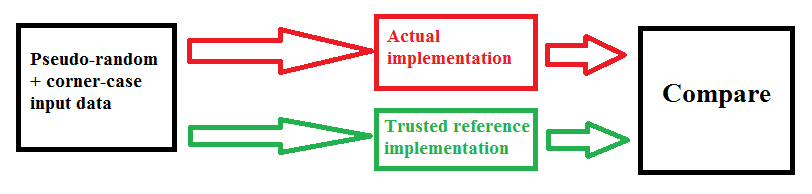
We have accurate, mathematically correct FDCT/IDCT reference implementations in our test code base. We should always test the new ones against them.