
All glory and honor to God יהוה in the name of Yeshua the Messiah (Jesus Christ).
Intelligent, Security-Conscious, and Designed for Effortless Productivity — Because With Rullst, We Rule!





Quickstart · Start building · Rullst Academy · Live examples · Documentation · Discord
cargo install cargo-rullst --version '^12' --locked
cargo rullst new my_app    # choose Blank/API, Blog, SaaS, LMS, Portfolio or ERP
cd my_app
cargo rullst dev           # rebuilds and restarts every time you save
That's it: a running application, generated as readable Rust you can change —
no hidden runtime magic. The selector installs the latest stable v12 CLI; use a
full version such as --version 12.1.2 to reproduce a specific release.
Installation and prerequisites · Zero-to-Hero tutorial · Build a JSON REST API · CLI reference
Prefer an interactive dashboard? Run cargo rullst dash
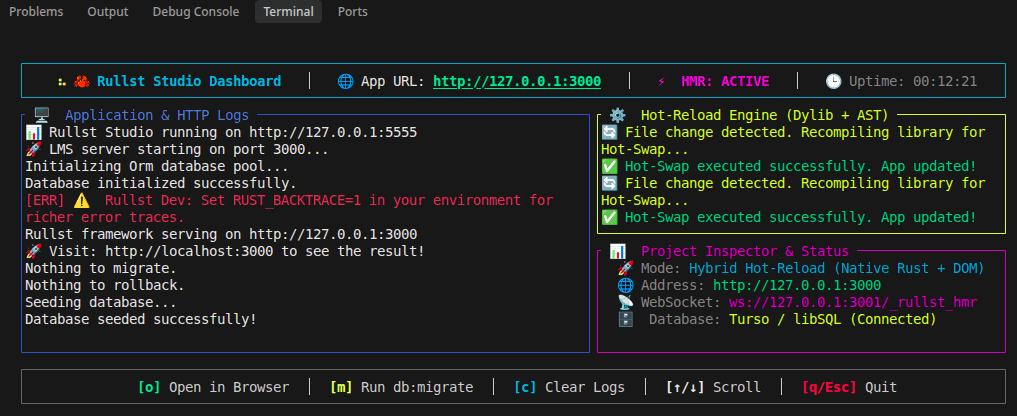
Recorded screenshot; layout and controls can differ by version. Development workflow.
use rullst::{html, response::Html, routes, Server};

async fn home() -> Html<String> {
    Html(html! {
        <div class="min-h-screen bg-slate-900 text-emerald-400 flex flex-col items-center justify-center font-sans">
            <h1 class="text-5xl font-extrabold mb-4">"Hello, Rullst! 📜🦀"</h1>
            <p class="text-slate-400 text-lg">"Your first typed route is running."</p>
        </div>
    })
}

#[tokio::main]
async fn main() -> Result<(), Box<dyn std::error::Error>> {
    let app = routes![
        get("/" => home)
    ];

    Server::new(app).run(3000).await?;
    Ok(())
}
HTML lives in a compile-time html! macro, routes are typed and pages are
server-rendered — HTMX-ready, with no JavaScript bundle to build. This snippet
comes from the Zero-to-Hero tutorial,
and every tutorial's Rust code is compiled in CI.
Prefer a JSON API?
use rullst::{Server, ServerError, routes, server::Json};
use serde::Serialize;

#[derive(Serialize)]
struct HealthResponse {
    status: &'static str,
    framework: &'static str,
}

async fn health() -> Json<HealthResponse> {
    Json(HealthResponse {
        status: "ok",
        framework: "Rullst",
    })
}

#[tokio::main]
async fn main() -> Result<(), ServerError> {
    let app = routes![
        get("/api/health" => health),
    ]
    .layer(rullst::server::from_fn(
        rullst::security::headers_middleware,
    ));

    Server::new(app).run(3000).await
}
curl http://127.0.0.1:3000/api/health
# {"status":"ok","framework":"Rullst"}
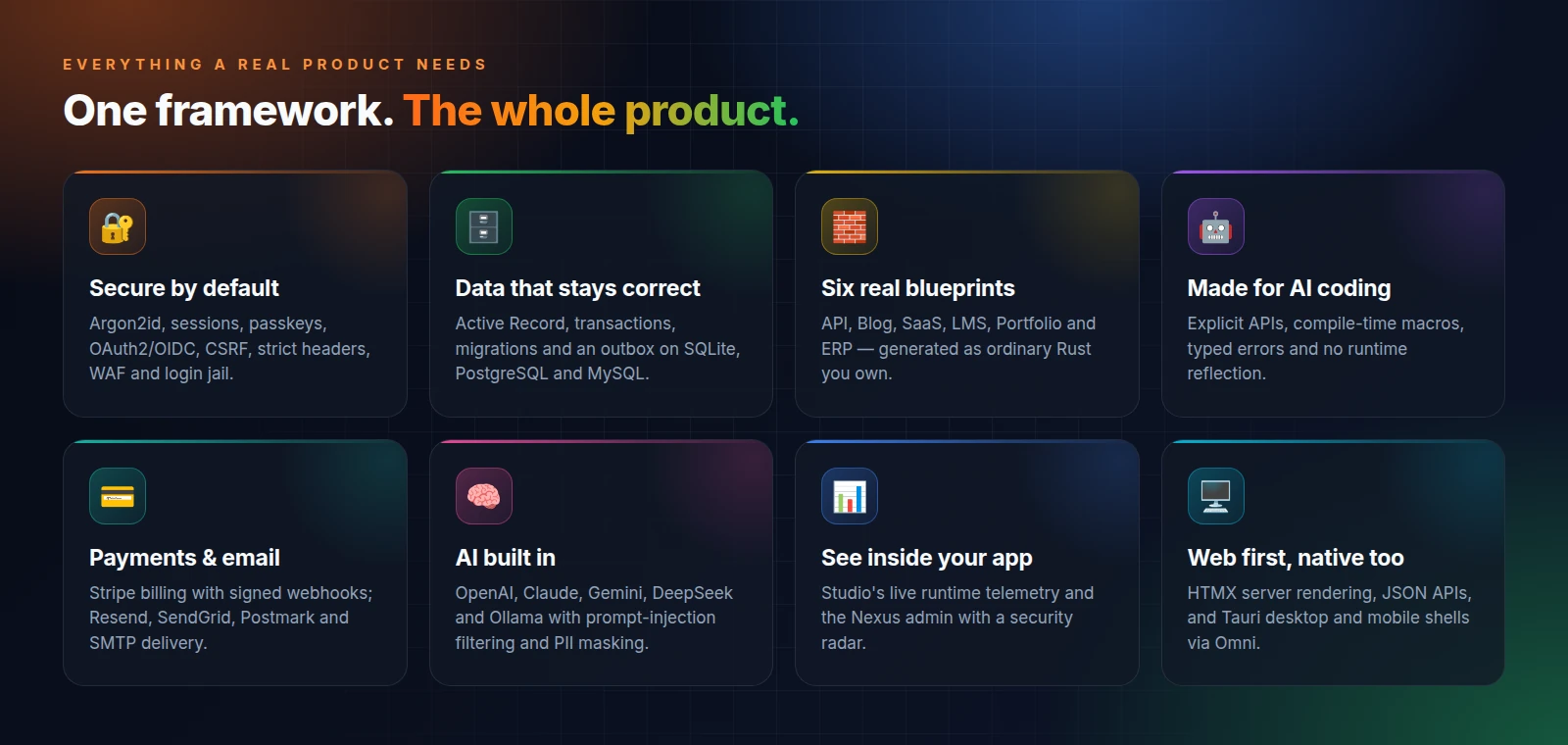
Every capability has a documented boundary — security middleware does not replace your authorization rules, and databases are not interchangeable. See the capability ledger · Why Rullst? · Axum & SQLx escape hatches
Real applications running today, every one of them built with Rullst. Click to explore — their code and deployment recipes live in Rullst/examples.
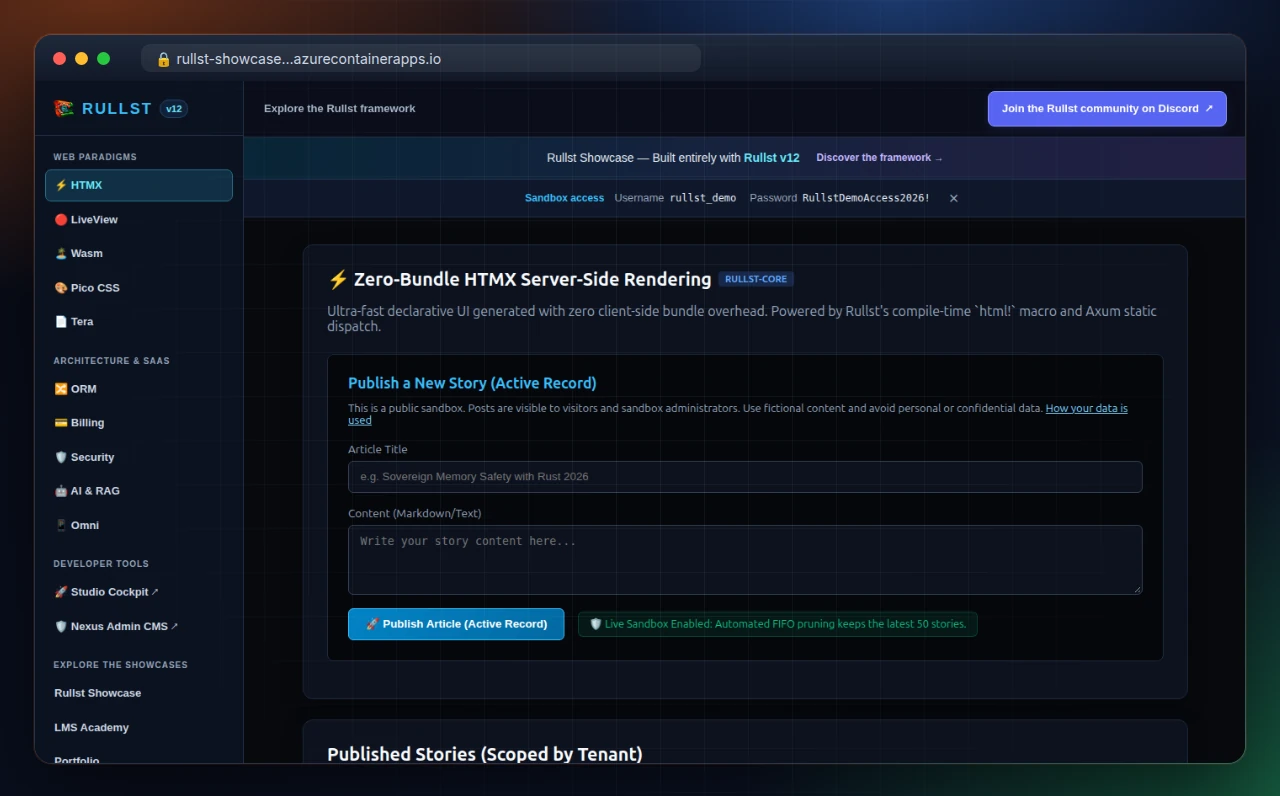
🌐 Showcase — SSR, LiveView, Wasm, ORM, billing, security and AI demos · Open ↗ |
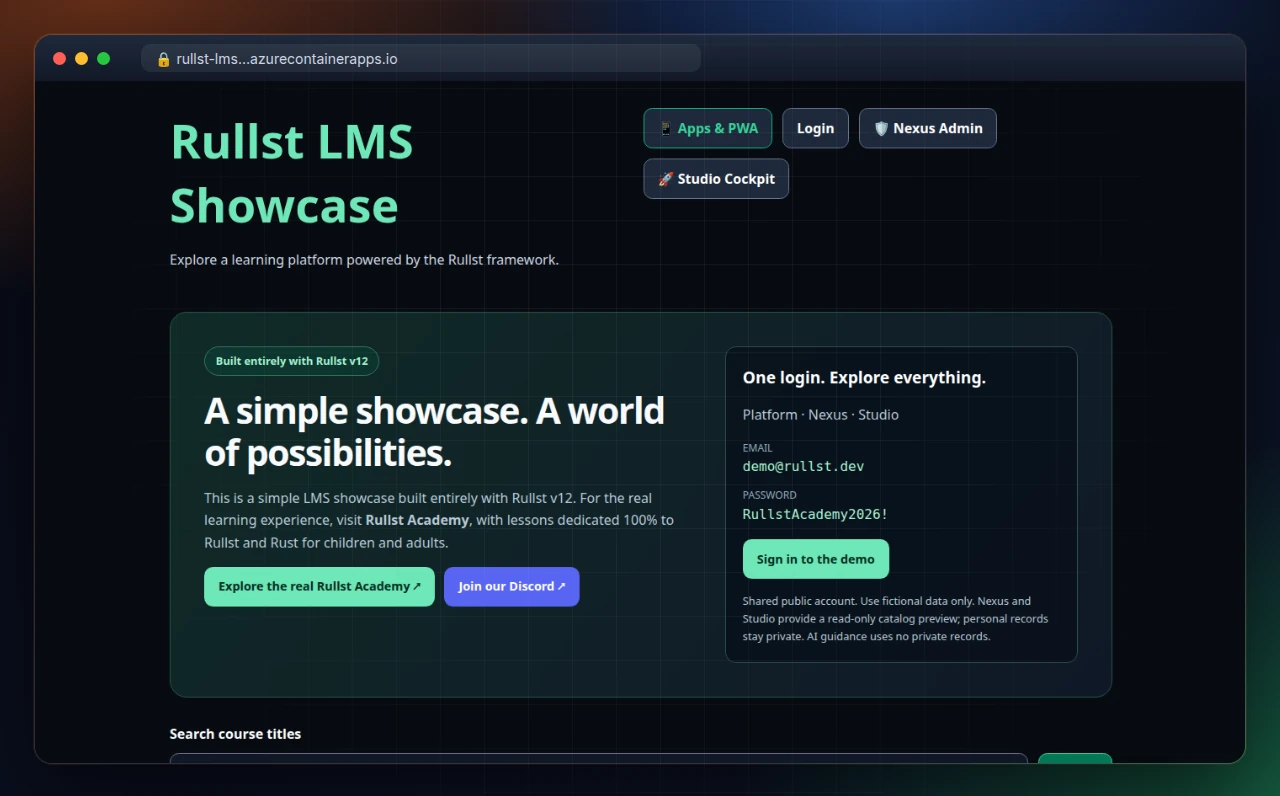
🎓 LMS — course catalog and learning platform · Open ↗ |
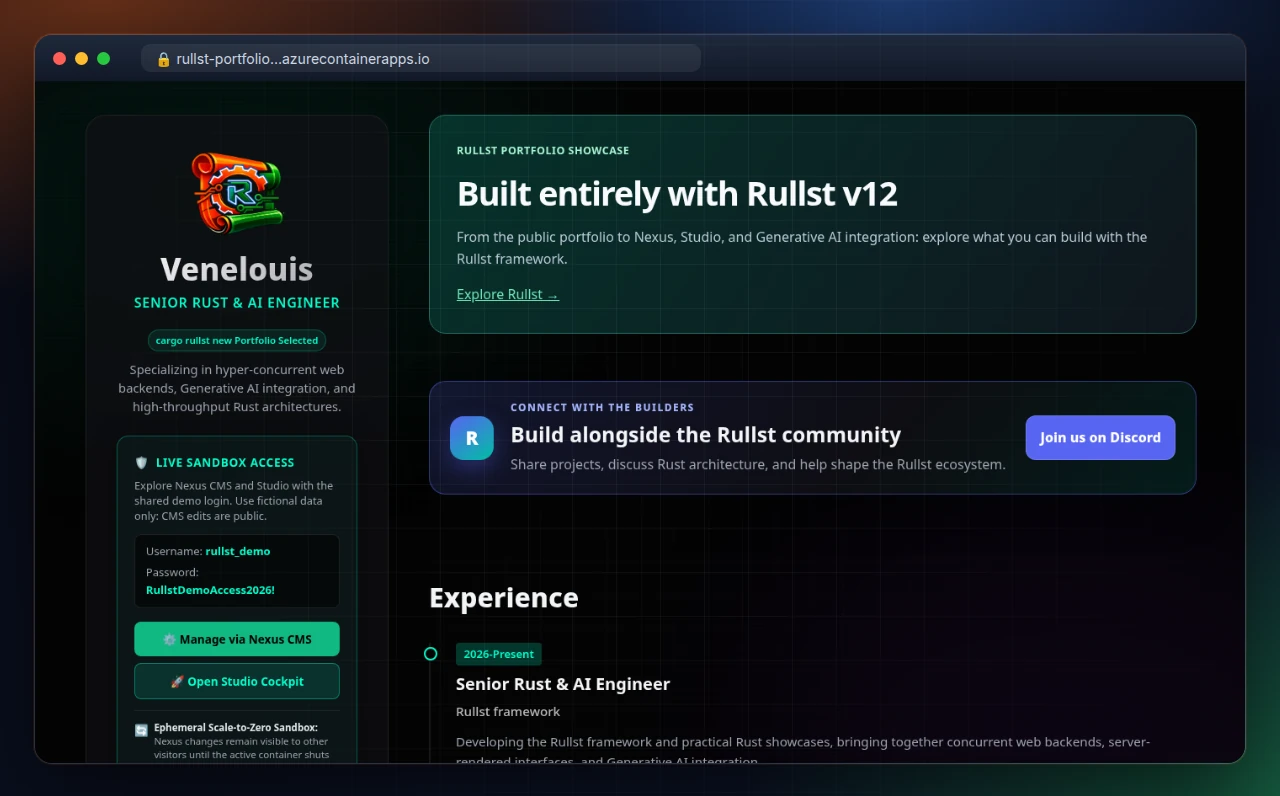
💼 Portfolio — projects, experience, Nexus and Studio · Open ↗ |
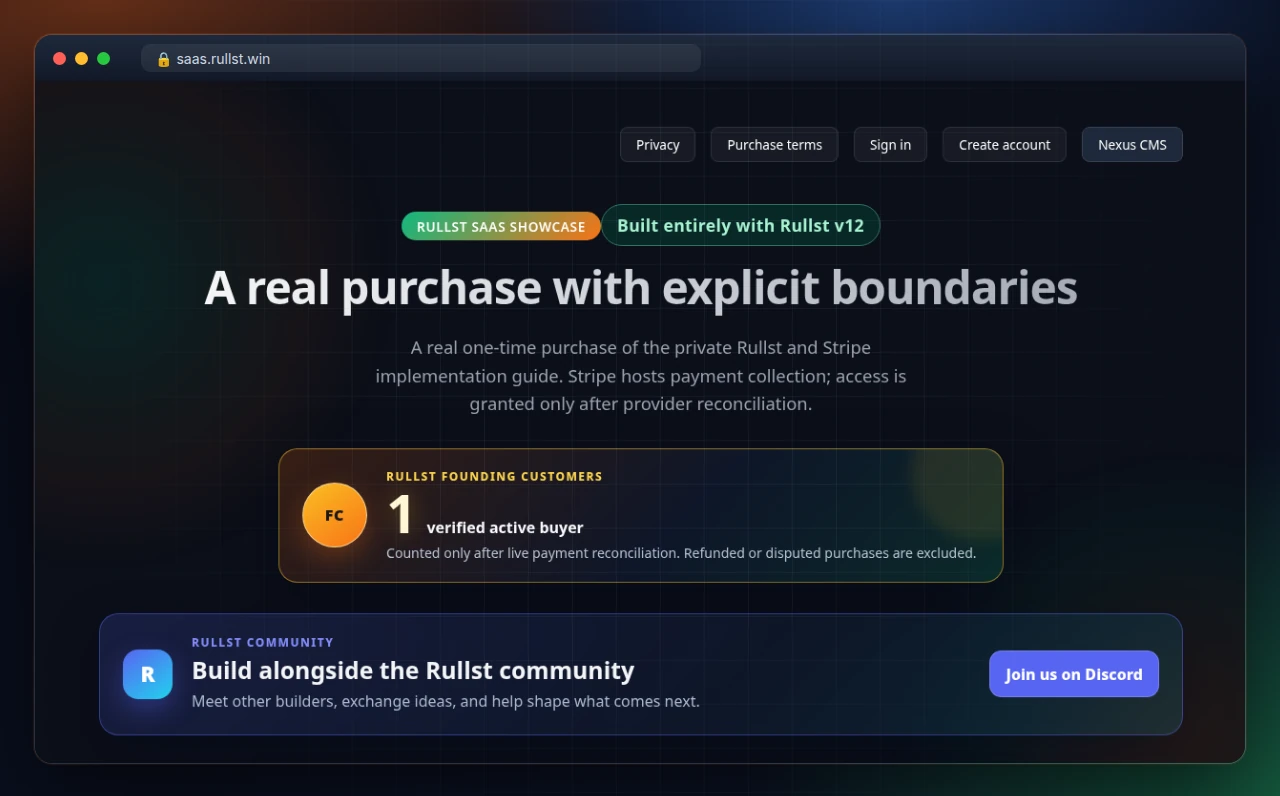
🛒 SaaS in production — real purchases with Stripe · Open ↗ |
The demos scale to zero when idle, so the first visit can take a few seconds to wake up — that is hosting startup, not Rullst's request time. The SaaS checkout is live and charges real money; the Showcase payment demos are not.
Prefer to run something locally? The reproducible SaaS example covers generation, login and tenant-scoped notes on a disposable SQLite database, and the WebGPU wave example serves browser graphics from Rullst.
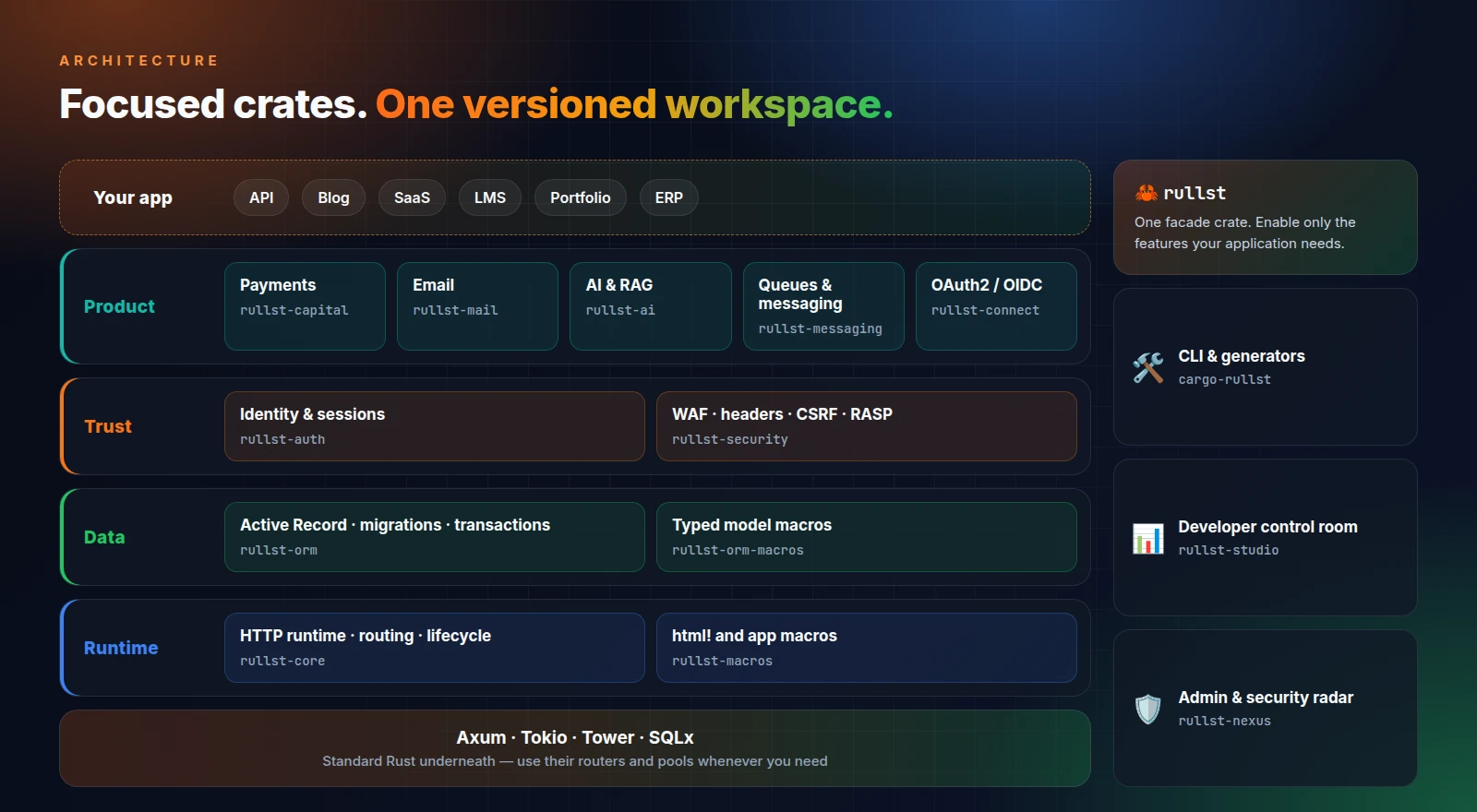
Rullst is a family of focused crates in one versioned workspace — select only what your application needs. The stable v12 release publishes sixteen crates; detailed feature and provider boundaries live in the specification.
Browse the crate directory
| Crate | Focus |
|---|---|
| rullst | Public framework facade and feature selection |
| rullst-core | HTTP runtime, routing, lifecycle and telemetry |
| rullst-orm | Relational models, transactions and capability-specific persistence |
| rullst-auth | Passwords, sessions, passkeys and authorization helpers |
| rullst-security | Defense-in-depth middleware, guards and audit helpers |
| rullst-connect | OAuth2/OIDC identity integrations |
| rullst-ai | Guarded local/cloud clients and tenant-aware retrieval |
| rullst-capital | Payment/payout adapters, webhooks and bounded billing helpers |
| rullst-mail | Transactional email and delivery controls |
| rullst-messaging | Broker-neutral contracts and durable local messaging |
| rullst-studio | Local developer control room |
| rullst-nexus | Registered-model admin with explicit access policy |
| rullst-iot | Bounded no_std helpers and signed OTA verification, not device integration |
| rullst-macros | Compile-time HTML and application macros |
| rullst-orm-macros | Typed ORM code generation |
| cargo-rullst | Project scaffolding, development and upgrade CLI |
Rullst Academy is a free learning platform — built with Rullst — where you can learn Rust, Rullst, Git/GitHub, web development, databases and more through short lessons and practical projects, in Portuguese, English or Spanish.
Start learning at Rullst Academy ↗
Rullst is maintained with the rigor you expect from security software:
- No panics in production code, enforced by CI across the published runtime crates.
- No new
unsafeoutside a reviewed OS/FFI allowlist. - At least 90% line coverage, enforced, plus fuzzing, property tests, sanitizers and Kani/Miri checks on selected critical code.
- Supply-chain hygiene: RustSec and license policy on every change, SHA-pinned Actions, and an SBOM with build-provenance attestation for every release.
- A fast Linux gate on every pull request, with the complete Linux/macOS/Windows matrix every night and before every release.
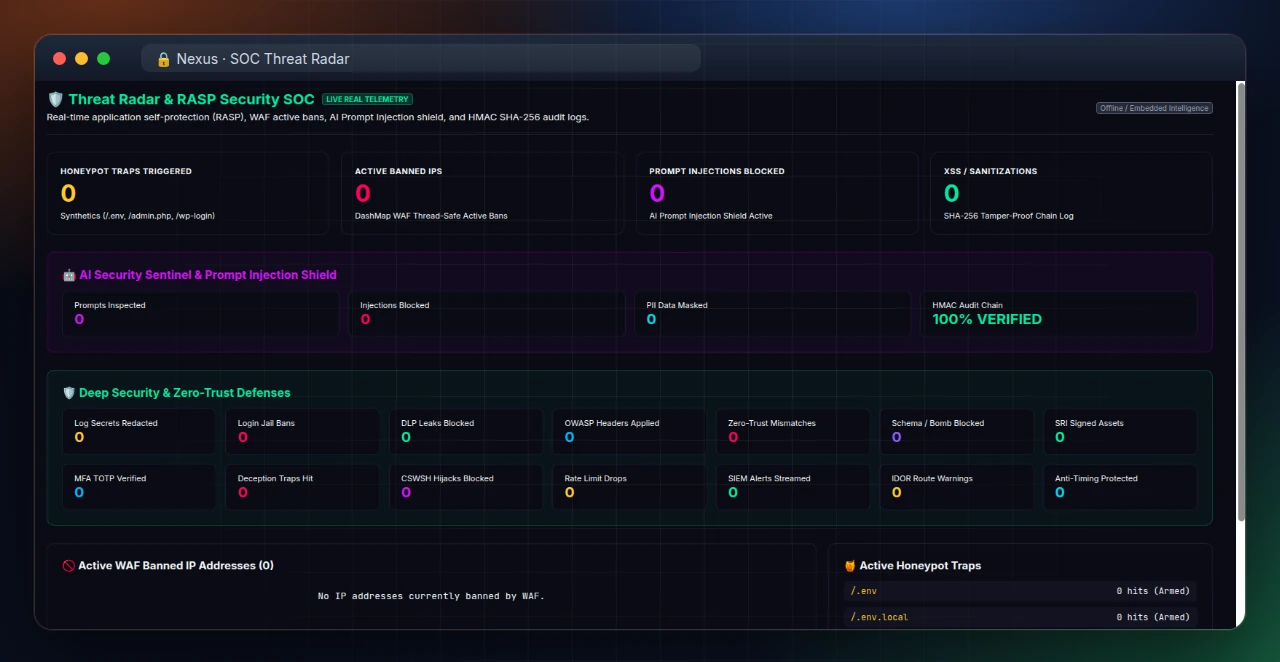
The Nexus security radar (recorded screenshot).
These results are evidence for their stated scope, not a security certification of every application built with Rullst. Explore the release audit, capability status and quality scorecard.
🛡️ Open the verification dashboard (39 workflows)
Badges are pinned to the main branch; they report the latest matching run, not a certification or deployment guarantee.
| Continuous or change-aware gate | Development main status |
Actual scope |
|---|---|---|
| Rust CI |  |
Format, all-target/all-feature Clippy, a Linux gate on pull requests, every Linux shard after merge and the complete Linux/macOS/Windows matrix nightly; Cargo-aware doctests sourced from all 52 public tutorials, strict DB boundaries, feature boundaries, generated-code checks, and MSRV 1.96.0. |
| Declared MSRV |  |
Every publishable manifest declares Rust 1.96.0 and CI runs an explicit workspace all-feature check with that toolchain. |
| GitHub Actions lint |  |
Validates workflow syntax, expressions, embedded shell, and full-SHA third-party Action pins. |
| Documentation |  |
Builds the mdBook and rejects broken local links and anchors; scheduled/manual runs also preserve an informational external-link report. |
| End-to-end smoke |  |
Boots the release blog example and verifies HTTP, security headers, form flow, and SQLite persistence. |
| Codecov — whole repository | |
The badge reports the current branch aggregate. The stable-source LLVM run at eb11f892 measured 90.3220% (79,813/88,365 lines) before Codecov upload. The enforced repository floor is ≥90% with zero tolerance. |
| Codecov — framework libraries |  |
Runtime libraries are enforced separately at ≥90%. CLI and proc-macro components stay separately visible; Coverage CI uploads their real LCOV evidence with OIDC. |
| Cargo Audit |  |
RustSec advisory scan with only governed, expiring exceptions; the daily run also audits the stable v12 locks. |
| Security exception governance |  |
Cross-checks scanner allowlists against the owner/expiry ledger, then independently reruns Cargo Audit. |
| Cargo Deny |  |
Advisory, license, ban, and source policy. |
| CodeQL SAST |  |
Rust semantic analysis after an all-target/all-feature build. |
| OpenSSF Scorecard |  |
The badge renders the score from the official public Scorecard JSON report; the pinned Scorecard workflow publishes OIDC-authenticated results on each main push and weekly. A score is evidence, not a security certification. Evidence and improvements. |
| Cargo Machete |  |
Unused direct dependency detection. |
| SemVer checks |  |
Supported library APIs are compared with exact latest non-yanked registry baselines; never-published packages and unsupported proc-macro/binary surfaces are reported explicitly. |
| Zero-panics policy |  |
Denies panic-family operations in published production targets and generated runtime templates. |
| Unsafe boundary |  |
Denies new production unsafe code outside the reviewed OS/FFI allowlist. |
| Secret scanning |  |
Verified-secret scan across the configured Git history range. |
| Spellcheck |  |
Repository-wide typo detection. |
| Crate architecture policy |  |
Compares the real publishable-crate dependency graph with a versioned, reviewed repository policy. |
| WebAssembly matrix |  |
Compiles Core, the public facade and macros for browser Wasm and WASI Preview 1. |
Bare-metal no_std matrix |
 |
Builds IoT helpers for Cortex-M and RISC-V targets; this is compile evidence, not hardware testing. |
| IoT integration |  |
Host tests, signed OTA invariants, and a Cortex-M build. |
| IoT crypto containment |  |
Path-aware signed OTA, Vault, advisory, and simulator-boundary checks; no PQC/HSM certification claim. |
| Omni desktop matrix |  |
Generates fresh web shells and checks their Tauri crates on Linux, macOS and Windows; no installer, signing or store claim. |
| Omni Android compile |  |
Generates a fresh shell and compiles an unsigned Android debug APK; no physical-device, Play testing/signing or store claim. |
| Omni iOS simulator |  |
Path-aware fresh scaffold generation and compilation on a macOS iOS simulator target; no device, signing or App Store claim. |
| PR security evidence |  |
Pull-request-only bounded IDOR/RBAC heuristics and CycloneDX SBOM artifact. It intentionally has no continuous main status. |
Deep or irreversible workflows are intentionally not presented as continuously green main gates:
| Deep evidence | Trigger and enforcement |
|---|---|
| Benchmark regression | Weekly, main push, or manual; eight published groups backed by nine Criterion benchmark binaries emit non-blocking alerts at a 20% regression. |
| Property testing | Weekly/manual release-mode invariant testing with 10,000 configured cases. |
| TSan and ASan | Daily/manual package matrices on a pinned verifier-only nightly. |
| Fuzzing / corpus minimization | Forty manual libFuzzer jobs; weekly/manual corpus maintenance is informational. |
| OWASP ZAP | Manual baseline over three release surfaces: generated REST API and complete LMS are blocking with no ignored alerts; the deliberately CDN-backed blog showcase remains an explicitly informational boundary. |
| Kani, Miri, mutation testing, cargo-udeps | Manual or scheduled research signals: selected Kani/Miri scopes are strict, while mutation and unused-dependency findings remain explicitly informational. |
| v13 Verus pilot | Optional production-linked age-policy proof with pinned tooling and three negative controls. Hosted registration/acceptance remains pending; no framework-wide correctness claim. |
| GitHub Pages | Deploys development documentation from main; it is not a code-quality gate. |
| Release and provenance | Exact version tags only: full verification, package-all, evidence bundle, checksums, GitHub build-provenance attestation, changelog-derived release notes, and ordered crates.io publication. This does not claim a project-wide SLSA level or independent certification. |
Scheduled events use the repository's default branch, so scheduled and
continuous development evidence refer to main; stable v12 has its own branch.
The branch-protection profiles and the exact scope of all
39 workflow definitions in this source branch are documented in
WORKFLOWS.md.
📖 Read the detailed breakdown of all CI/CD and security workflows.
🧭 Capability Status & Vision Decisions preserves ambitious features that are partial or not implemented, with an explicit recommendation and rationale for each one.
📋 Simple Capability Status and the per-commit quality scorecard keep feature progress separate from SHA-bound engineering evidence.
From an existing application's root:
cargo rullst upgrade --dry-run
cargo rullst upgrade
The CLI coordinates dependency updates, backs up controlled files and runs compiler checks. Review the plan and your application's behavior; it does not migrate production data. Assisted upgrade tutorial · v5 → v12 migration guide
This main branch is where v13 is being built (13.0.0-alpha.1). The
commands above install the stable v12 line, maintained on the
v12 branch; v5 is no longer maintained.
In development for v13: email login and scoped API tokens, active-session management with remote logout, private S3/R2 storage with resumable uploads, durable outgoing webhooks and recurring jobs, Redis Streams messaging, distributed tracing and a recoverable Live UI. Until v13 is released, these are development candidates, not shipped features.
v13 roadmap · v13 adoption guide · Compatibility policy · v12 release record
The benchmark hub publishes eight Criterion groups backed by nine benchmark binaries. They measure specific workloads and regressions — not universal speed or a ranking of frameworks. Read the methodology alongside the results.
Try a blueprint, report a reproducible bug, improve a tutorial or contribute a focused change with tests. Documentation, accessibility and integration feedback matter as much as new features.
Contributing · Issues · Discord · Community links · Our story and philosophy
⭐ If Rullst sparks your curiosity, a star helps more developers discover it.
MIT license · Report a vulnerability privately · Website privacy notice
All glory and honor to God יהוה in the name of Yeshua the Messiah (Jesus Christ).
